Debt Consolidation Loans vs. DIY Payoff: Which Path Is Right for You?
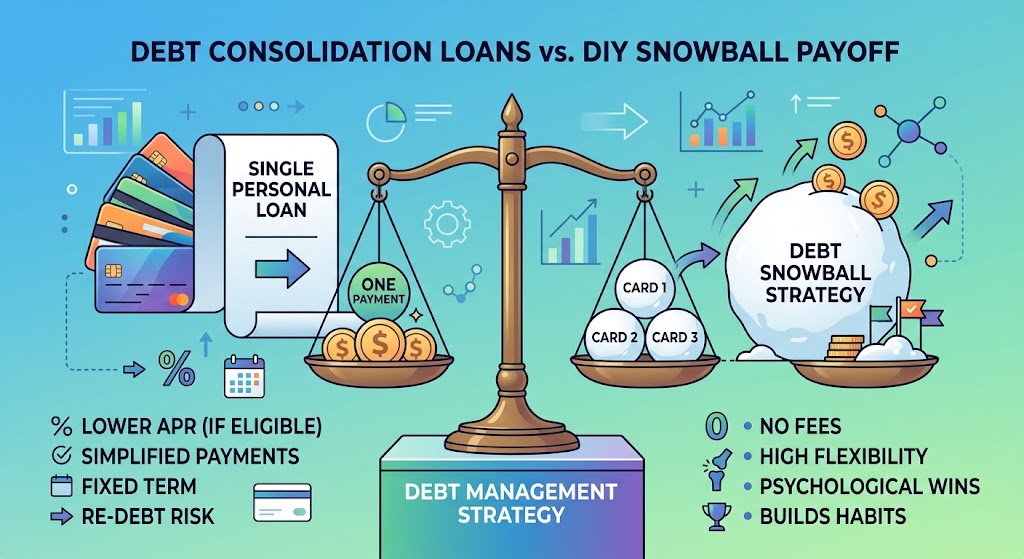
When you are juggling four or five credit card balances with varying due dates, minimum payments, and soaring interest rates, combining them all into a single debt consolidation loan sounds incredibly appealing.
One single payment. One fixed interest rate. One fixed end date.
However, debt consolidation is not debt elimination. Shifting debt from credit cards to a personal loan changes who you owe, but it doesn't change what you owe.
Here is a realistic comparison between taking out a Debt Consolidation Loan versus executing a DIY Payoff Strategy (like the Debt Avalanche or Debt Snowball) so you can decide which route fits your situation.
Option 1: Debt Consolidation Loans
A debt consolidation loan is an unsecured personal loan used to pay off multiple credit card balances at once. Moving forward, you pay a single fixed monthly installment to the loan provider over a fixed term (typically 2 to 5 years).
The Pros: Lower potential APRs (9%–14% vs. 21%–28% card APRs), fixed end date, and simplified single monthly payment.
The Hidden Cons & Traps: Origination fees (1%–8%), strict credit score eligibility, and the dangerous "clean slate trap" of running up credit cards again after paying them off.
Option 2: Structured DIY Payoff (Avalanche or Snowball)
A DIY payoff strategy leaves your credit accounts where they are. You make minimum payments on all accounts while directing every extra available dollar toward a single targeted card using either the Debt Avalanche (highest APR first) or Debt Snowball (smallest balance first).
The Pros: No qualification needed, zero fees, maximum budget flexibility, and builds long-term budgeting habits.
The Cons: Requires active self-discipline across multiple due dates and higher total interest if not accelerated aggressively.
Comparison Summary: Loans vs. DIY Payoff
Feature |
Debt Consolidation Loan |
DIY Payoff (Avalanche / Snowball) |
Setup Cost |
1% – 8% Origination Fees |
$0 |
Credit Requirement |
Good to Excellent (680+) |
None |
Interest Structure |
Fixed rate for term length |
Variable (revolving APR) |
Payment Flexibility |
Rigid monthly installment |
Flexible (above minimums) |
Primary Risk |
Re-accumulating debt on empty cards |
Payoff fatigue / loss of momentum |
How to Choose Your Path
Choose a Consolidation Loan IF: You have a solid credit score, qualify for a low APR that significantly beats your weighted average credit card rate, have addressed spending habits, and want a fixed, unchangeable monthly schedule.
Choose a DIY Payoff Strategy IF: You want to avoid loan fees, need flexibility in your monthly budget, are working on improving your credit score, or want to use the mathematical speed of the Debt Avalanche to systematically eliminate cards one by one.
Compare Both Strategies in Real Time
Unsure whether a loan payment beats an accelerated DIY strategy? Don't guess—run the math.
👉 Use Cut The Card's DIY vs. Loan Strategy Calculator – Enter your current credit card balances, APRs, and prospective loan terms to compare monthly payments, total interest costs, and exact payoff dates side by side!
Enjoyed this post? Never miss an update!