
De-Trashing Your Digital Wallet: How One-Click Checkout Triggers Credit Card Relapse
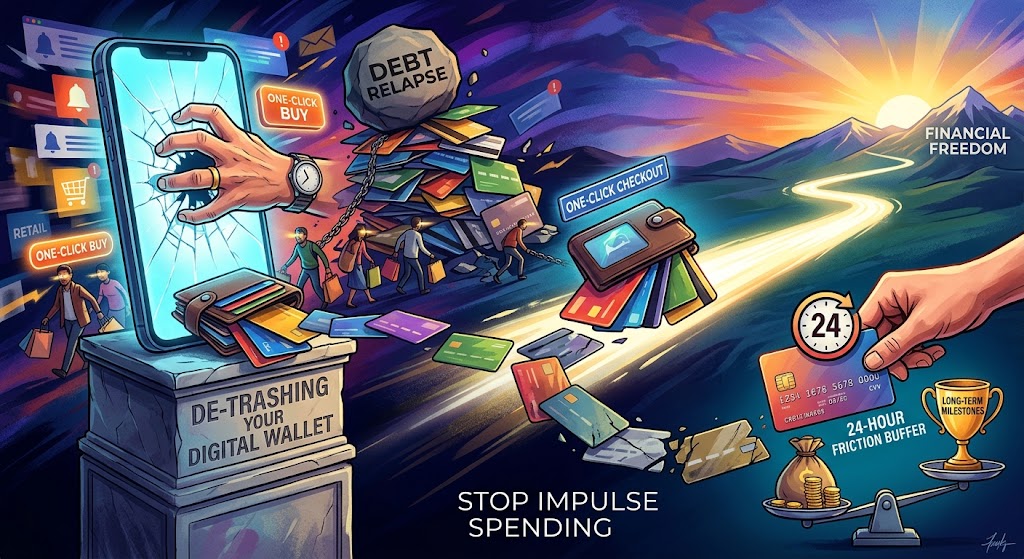
Paying off credit cards requires changing your relationship with spending. But today, the biggest obstacle isn't a lack of willpower—it's the engineered absence of friction.
E-commerce platforms, food delivery apps, and mobile wallets have spent billions eliminating every single point of friction between wanting an item and buying it. With Apple Pay, face recognition, and Amazon 1-Click, you can buy a $200 jacket in under three seconds without ever seeing a card number or feeling the psychological weight of spending money.
If you are trying to pay off debt while keeping high-interest credit cards stored in your digital wallets, you are fighting a losing battle against behavioral psychology. Here is how to de-trash your digital wallet and regain control.
The Psychology of Frictionless Spending
When you pay with physical cash, your brain registers a pain point known as the *Pain of Paying*. Handing over physical paper notes creates a immediate sense of loss.
Swiping a credit card reduces that pain. Storing a credit card in a digital wallet or browser autofill eliminates it completely. When there is zero time to reflect on whether a purchase fits your budget, impulse spending wins every time.
The 4-Step Digital Detox Plan
1. Scrub Browser Autofill: Go into Chrome, Safari, or Edge settings and delete all saved credit card profiles. Turn off 'Allow sites to check if you have payment methods saved.'
2. Remove Cards from Mobile Wallets: Open Apple Wallet or Google Wallet and remove your credit cards. Keep only a debit card connected to your daily spending buffer account.
3. Unlink One-Click Merchants: Log into Amazon, Target, PayPal, DoorDash, and Uber. Remove stored credit card details so that future orders require manual card entry.
4. Unsubscribe from Marketing Emails: Use a service or spend 10 minutes unsubscribing from retailer promotional newsletters. If you don't see the flash sale, you won't feel the urge to buy.
Enforcing the 24-Hour Friction Buffer
By forcing yourself to physically locate your wallet, take out a card, and manually type in 16 digits, an expiration date, and a CVV code, you reintroduce crucial thinking time.
For any non-essential purchase over $50, enforce a mandatory **24-Hour Rule**. If you still want the item 24 hours after adding it to your cart and manually typing in card details, review your budget and decide if it fits your goal.
Focus on Milestones Over Impulse Rewards
Swapping instant impulse hits for long-term financial milestones is the key to lasting freedom.
👉 Track Your Payoff Milestones on Cut The Card – Celebrate hitting $1,000, 25%, 50%, and $0 debt milestones on your dashboard instead of chasing short-lived checkout thrills!
Enjoyed this post? Never miss an update!