

The 0% APR Balance Transfer Playbook: When It Works (and When It Backfires)
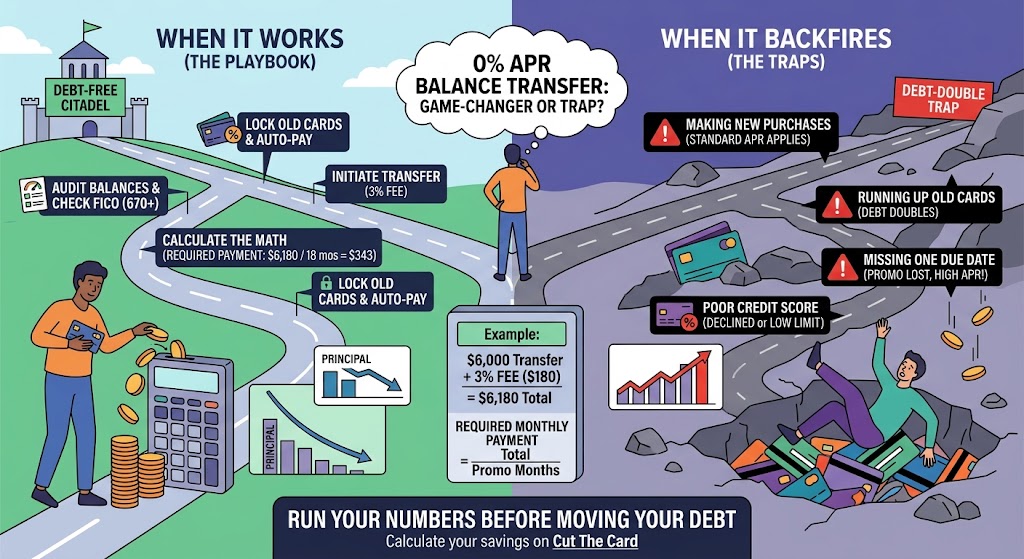
When you’re paying 22%, 26%, or even 29% APR on revolving credit card balances, a large chunk of every payment goes straight to interest rather than reducing what you actually owe.
Enter the 0% APR balance transfer card.
On paper, it sounds like a silver bullet: shift your existing credit card debt over to a new card offering 0% APR for 12, 18, or 21 months, stop paying interest entirely, and pour every single dollar into crushing the principal.
While balance transfers can be a game-changer, they can also backfire into a dangerous financial trap if executed without a strict plan. Here is the complete playbook on how balance transfers work, the math behind them, and how to avoid falling into debt twice.
How a Balance Transfer Works (and the Math You Can't Ignore)
A balance transfer isn’t debt forgiveness; it’s moving money from a high-interest bucket into a zero-interest bucket for a limited window of time. However, "zero interest" doesn't mean free.
1. The Balance Transfer Fee (3% to 5%)
Virtually every balance transfer card charges a one-time fee to move your balance over. This fee is typically 3% to 5% of the transferred total, with a $5 or $10 minimum.
Example: If you transfer $6,000 with a 3% fee, $180 is immediately added to your balance, bringing your starting debt to $6,180.
Is it worth it? If you were paying 24% APR on that $6,000, you were racking up roughly $120 in interest every single month. Paying a $180 one-time fee to eliminate interest for 18 months saves you thousands in net interest charges.
2. The Promo Window Math
To make a balance transfer work, you must divide your total balance (including the transfer fee) by the exact number of months in the promotional window:
Required Monthly Payment = (Transferred Balance + Transfer Fee) / Promotional Months |
If you transfer $6,180 onto an 18-month 0% APR card, you must pay $343.33 per month to hit $0 before the 0% rate expires. If you only pay the minimum monthly amount, you will land at the end of the promotional period with a remaining balance that instantly converts to the card's standard, high APR.
The 4 Biggest Traps That Cause Balance Transfers to Backfire
Trap 1: Making New Purchases on the Card. Never, under any circumstances, use a balance transfer card for daily spending. Many cards treat new purchases differently than transferred balances, charging standard APR on grocery runs or coffee while keeping the transferred balance at 0%. It confuses your payoff accounting and fuels spending habits you are trying to break.
Trap 2: Running Up the Old Credit Cards. This is the most common reason balance transfers fail. Once you clear a $5,000 balance off an old Visa, that card suddenly shows a $0 balance and full available credit. If you don't address the underlying spending habits, you risk rebuilding debt on the old card while still owing money on the new balance transfer card—doubling your total debt load.
Trap 3: Missing a Single Due Date. Read the fine print of your balance transfer agreement: a single late or missed payment can void your 0% APR promotional rate, instantly triggering deferred or standard high APR across your entire remaining balance. Set up auto-pay for at least the minimum amount immediately.
Trap 4: Credit Score Eligibility. Most top-tier 0% APR transfer cards require a good to excellent credit score (typically 670+ FICO). If your credit score has dipped due to high credit utilization, you may either be declined or approved for a credit limit far lower than the debt you need to transfer.
The Step-by-Step Balance Transfer Execution Plan
1. Audit Your Balances: List out your high-interest credit cards, their APRs, and current balances.
2. Shop for Pre-Qualified Offers: Look for cards offering 0% intro APR on transfers for 15–21 months with low balance transfer fees (3% preferred). Check pre-qualification tools that won't impact your credit score.
3. Calculate Your Target Payment: Plug your balance and transfer fees into a balance transfer calculator to confirm you can realistically afford the monthly payoff figure required before the promo ends.
4. Initiate the Transfer: Once approved, request the balance transfer directly through the new issuer's portal. It can take anywhere from 5 to 14 days to complete. Keep paying minimums on your old cards until you see the old balances hit $0.
5. Put the Old Cards on Lock: Hide the physical cards, remove them from digital wallets, and set up an automated monthly payment on your new card.
Run Your Numbers Before Moving Your Debt
Before applying for a balance transfer card, make sure the math works in your favor.
👉 Calculate Your Balance Transfer Savings on Cut The Card – Plug in your current balances, APRs, and prospective transfer terms to see your exact required monthly payment and net interest savings.
Ready to explore your options? Browse our curated list of Top Recommended 0% Intro APR Balance Transfer Cards to compare promotional windows, fee structures, and pre-qualification requirements.
Enjoyed this post? Never miss an update!