

How to Build an 'Anti-Debt' Emergency Buffer (While Still Paying Off Balances)
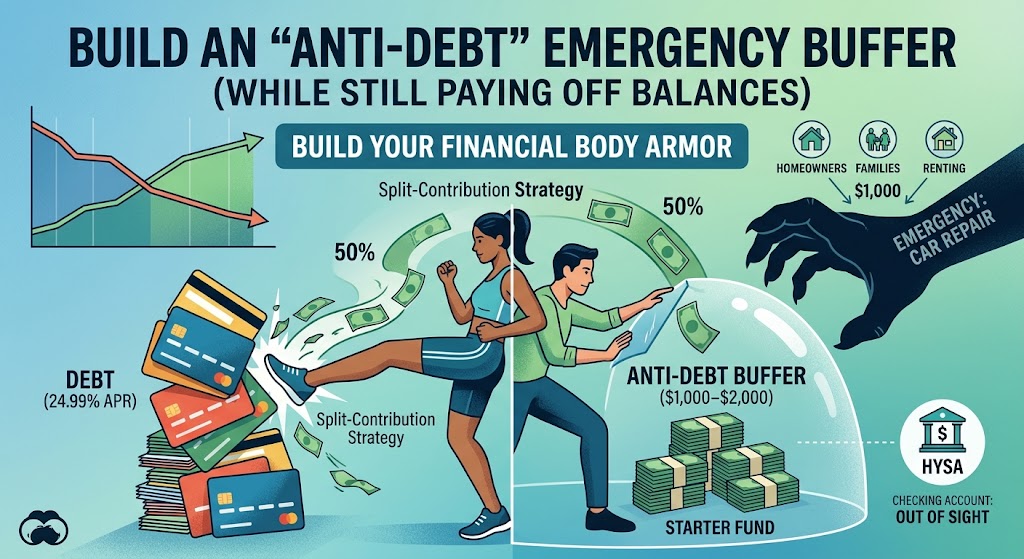
When you commit to paying off credit card debt, the instinct is to be as aggressive as possible: throw every single extra dollar from your paycheck straight at your highest-APR balance.
It feels mathematically logical. Why keep cash sitting in a checking account earning 0.5% interest when your credit cards are charging 24.99% APR?
Because without a cash safety net, you are living on a financial tightrope. The moment life happens—a flat tire, a prescription copay, or a unexpected plumbing issue—you have zero liquid cash to cover it. Your only option is to reach back for the exact credit card you’re trying to pay off.
This is the 'Debt Bounce-Back Cycle.' To break it permanently, you must build an 'Anti-Debt' Starter Emergency Buffer first.
Why 100% Debt Aggression Leaves You Vulnerable
When you have $0 in liquid savings, your credit card isn't just a payment method—it's your emergency fund. Every time an unexpected expense pops up, your debt payoff progress resets back to zero, destroying your psychological momentum.
An Anti-Debt Buffer acts as financial body armor. It stands between your daily life and your credit cards, ensuring that when surprises happen, you pay with cash and leave your debt payoff trajectory untouched.
How Big Should Your Starter Buffer Be?
A full emergency fund of 3 to 6 months' worth of expenses can take years to build—and sitting on $15,000 in cash while carrying 25% APR credit debt isn't optimal. Instead, target a realistic **Starter Buffer**:
$1,000 Starter Fund: Ideal for single earners, renters, or those with stable cash flow and lower total debt balances.
$2,000 Starter Fund: Recommended for homeowners, families with dependents, or households with variable or commission-based income.
Step-by-Step: The Split-Contribution Strategy
You don't have to pause your debt payoff entirely to build your buffer. Use the **Split-Contribution Strategy** until your $1,000–$2,000 target is met:
Phase 1 (Buffer Priority): Direct 50% of your extra cash flow into a High-Yield Savings Account (HYSA) and 50% toward your debt payoff queue until your starter fund hits its goal.
Phase 2 (Full Aggression): Once your $1,000–$2,000 starter fund is fully locked in place, divert 100% of your extra cash flow into your Debt Avalanche or Debt Snowball strategy.
Keep Your Buffer Out of Sight
To prevent yourself from dipping into your emergency buffer for non-emergencies (like a weekend dinner out or a online sale), keep the fund in a separate High-Yield Savings Account at a different bank than your primary checking account. The 1-to-2 day transfer delay adds just enough friction to prevent impulse spending.
Balance Savings and Payoff inside Cut The Card
Tracking your debt payoff alongside your cash reserves keeps your motivation high while protecting your progress.
👉 Use the Cut The Card Account Manager – Log your emergency buffer alongside your card balances to visualize your true net financial safety while you crush your debt!
Enjoyed this post? Never miss an update!