

The Daily Interest Hack: Why Making Bi-Weekly Payments Slashes Credit Card Interest
When you look at your credit card statement, you see a single APR figure—say, 24% or 28%. You also see a single monthly payment due date. Because of this layout, almost everyone pays their credit card bill once a month.
What most cardholders don't realize is that credit card issuers don't calculate interest once a month. They calculate interest every single day based on your Average Daily Balance.
By making one simple structural tweak—switching from one monthly payment to bi-weekly payments—you can turn the bank's daily interest compounding calculation into your competitive advantage.
The Math Behind the Hack: Average Daily Balance
To understand why bi-weekly payments work so well, you need to look under the hood at how daily interest is calculated.
First, your credit card bank takes your annual APR and divides it by 365 days to get your Daily Periodic Rate (DPR):
Daily
Periodic Rate (DPR) = Annual APR / 365 Days |
Every night at midnight, the bank multiplies that Daily Periodic Rate by the exact principal balance on your account that day. At the end of the billing cycle, all 30 daily interest charges are summed together and added to your bill.
Monthly vs. Bi-Weekly: A Side-by-Side Comparison
Imagine you carry a $10,000 balance at a 24% APR, and your target budget allows for a $400 monthly payment.
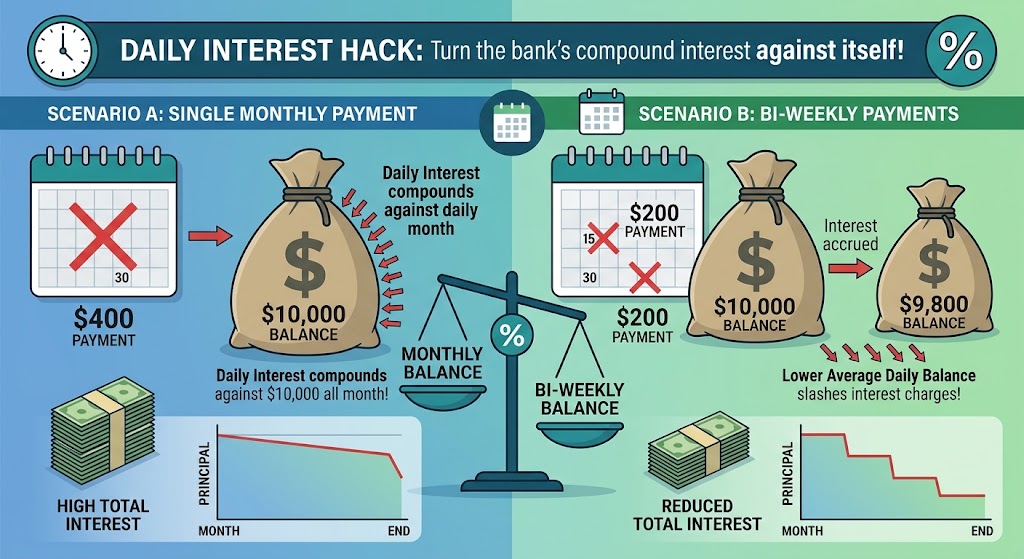
Scenario A: Making One $400 Monthly Payment
If you wait until the 30th day of the billing cycle to make your $400 payment, your account balance sits at $10,000 for 29 full days. Every single night, interest is charged against the full $10,000 balance. Only on day 30 does your balance finally drop to $9,600.
Scenario B: Making Two $200 Bi-Weekly Payments
Now suppose you split that exact same $400 into two $200 payments paid every two weeks:
Days 1 through 14: Your balance sits at $10,000, accumulating daily interest.
Day 15: Your first $200 payment posts. Your balance drops to $9,800.
Days 15 through 30: For the entire second half of the month, daily interest is calculated against $9,800 instead of $10,000.
Because your Average Daily Balance across the month was significantly lower, the bank charged you less interest for the cycle. More of your second payment went straight toward principal rather than interest.
The 26-Payment Bonus Advantage
There is a second, hidden power to bi-weekly payments: calendar alignment.
When you pay monthly, you make 12 payments a year. When you pay bi-weekly (every two weeks), there are 52 weeks in a year, which equals 26 bi-weekly half-payments—or the equivalent of 13 full monthly payments every year.
That extra full monthly payment happens automatically without feeling like a major budget sacrifice because it aligns directly with standard bi-weekly paycheck cycles.
How to Automate the Daily Interest Hack
1. Calculate Your Bi-Weekly Target: Take your total target monthly payment and divide it by 2.
2. Align Payments with Paydays: Set up automated online bill payments inside your bank account to execute the business day after every paycheck hits.
3. Verify Direct Posting: Confirm with your card issuer that multiple payments per billing cycle post immediately to your principal balance without penalty.
Test Custom Payment Frequencies on Cut The Card
Want to see exactly how much money and time you'll save by switching from monthly to bi-weekly payments?
👉 Test Custom Payment Frequencies in the Cut The Card Dashboard – Plug in your card balances and toggle between monthly and bi-weekly payment models to see your revised interest savings and accelerated payoff date in real time!
Enjoyed this post? Never miss an update!