How Your Credit Score Changes During a Debt Payoff Journey
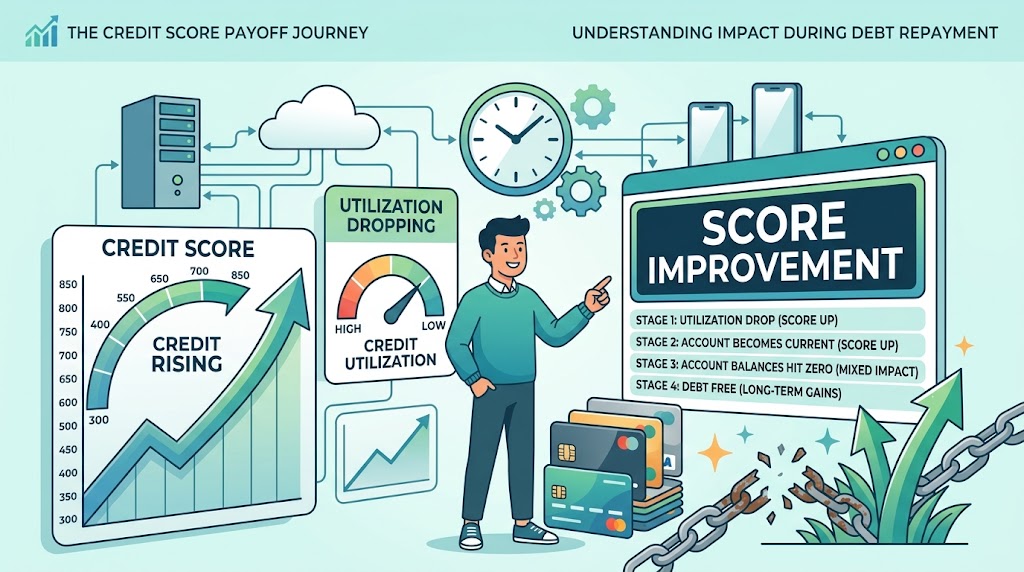
You've been working hard to pay down your credit cards. Your balances are shrinking, you're making payments on time, and you're finally seeing progress. Naturally, you expect your credit score to improve, too.
But what happens when your score barely moves, or worse, drops a few points?
Don't get discouraged. Your credit score doesn't always follow a straight upward path as you eliminate debt. Understanding what influences it can help you make better decisions without losing sight of your ultimate goal: financial freedom.
Why Paying Down Credit Cards Usually Helps Your Score
One of the most important factors in credit scoring is your credit utilization ratio, which measures how much of your available revolving credit you're using.
For example, imagine you have three credit cards with a combined credit limit of $10,000 and outstanding balances totaling $7,000.
Your utilization ratio is:
$7,000 ÷ $10,000 × 100 = 70% utilization.
Now imagine you pay your balances down to $3,000.
Your utilization drops to 30%.
Reducing utilization can improve your credit score because it indicates that you're relying less heavily on borrowed money.
While keeping utilization below 30% is a commonly recommended guideline, it's not a magic threshold. Lower utilization generally helps, and the balances on individual cards matter, too.
Why Your Credit Score Might Drop During Repayment
It seems unfair, doesn't it? You're making responsible financial decisions, yet your score occasionally decreases.
Several factors could explain this.
1. You closed a paid-off credit card. Closing an account reduces your total available credit. If you still carry balances on other cards, your utilization ratio could increase, potentially lowering your score.
2. Your credit report hasn't updated yet. Most card issuers report account information periodically, often around the statement closing date. Your latest payment may not appear immediately.
3. Other credit activity affected your score. A new credit application, missed payment, or change in another account could influence your score even while your credit card balances are declining.
4. You're viewing different scoring models. FICO and VantageScore use different calculations. Even scores produced by the same model can differ depending on the credit bureau and information available.
A temporary decrease doesn't necessarily mean your payoff strategy isn't working.
Should You Close Credit Cards After Paying Them Off?
Paying off a credit card feels fantastic. You might be tempted to close the account immediately and never look back.
However, keeping a paid-off card open can sometimes benefit your credit score.
Consider this example:
Account |
Credit Limit |
Balance |
|---|---|---|
Card A |
$5,000 |
$0 |
Card B |
$5,000 |
$2,000 |
Total |
$10,000 |
$2,000 |
With both cards open, your utilization is 20%.
If you close Card A, your available credit drops to $5,000, increasing utilization to 40%, assuming your balances and other limits remain unchanged.
That increase could negatively affect your score.
Closing a card doesn't necessarily erase its positive payment history immediately. Accounts closed in good standing can remain on your credit reports for years.
If the card has no annual fee and you can avoid unnecessary spending, keeping it open may be worthwhile. However, closing it can still make sense if fees, overspending, or account security are concerns.
Payment History Still Matters Most
Reducing balances is important, but consistently paying your bills on time is essential.
In commonly used FICO scoring models, payment history accounts for approximately 35% of your score, while amounts owed account for approximately 30%.
A single late payment reported to the credit bureaus can undermine progress you've made by reducing your balances.
To protect yourself, consider setting up automatic minimum payments and making additional payments whenever your budget allows.
Your goal should be to reduce debt without missing required payments along the way.
How Quickly Will Your Credit Score Improve?
There's no universal timeline.
If high credit utilization is holding your score down, improvements may appear after your lower balances are reported and reflected in a new score calculation.
For some people, that could happen within one or two reporting cycles. Others may see slower progress because of missed payments, collections, or other information in their credit reports.
Remember that past negative information may remain on your report even after you've paid the related debt.
The key is to focus on habits that strengthen your financial position over time rather than expecting an immediate increase after every payment.
Five Ways to Protect Your Score While Paying Off Debt
You can take practical steps to support your credit health throughout your payoff journey.
Never miss a payment. Set reminders or automatic minimum payments.
Reduce high credit card balances. Lower utilization can benefit your score.
Think before closing accounts. Consider available credit, fees, and spending habits.
Avoid unnecessary credit applications. New applications may temporarily affect your score.
Monitor your credit reports. Check for errors and confirm that payments and balances are reported accurately.
In the United States, you can access free credit reports through AnnualCreditReport.com.
Focus on Financial Freedom, Not Just a Number
Your credit score is an important financial tool, but it shouldn't become the only measure of your progress.
Every balance you reduce means less debt to manage. Every on-time payment helps establish responsible financial habits. And every dollar saved on interest is money you can put toward your future.
Your score may fluctuate along the way, but that doesn't erase the progress you're making.
Be patient, stay consistent, and remember that becoming debt-free is an achievement worth celebrating. You can do this!
See How Your Debt Payoff Plan Can Help You Move Forward
Understanding your credit score is one part of building a stronger financial future. Having a realistic plan to eliminate debt is another.
Explore the free debt planning tools at CutTheCard.net and discover how you can save money and time while working toward becoming debt-free.
Disclaimer: This article is for educational purposes only and does not constitute personalized financial or credit advice. Credit score changes vary depending on scoring models, credit reports, and individual financial circumstances.
👉 Start Your Debt Payoff Plan Today – See how Cut The Card helps you accelerate your journey to $0 balances.
Enjoyed this post? Never miss an update!